Flags of the Royal Navy
Naval flags are the coded signalling system of the Royal Navy: a fixed set of 26 letter flags plus numerals 0 to 9, together with the national, union and commissioning colours, that let warships talk to one another and to shore stations at up to 5 miles of clear sea.
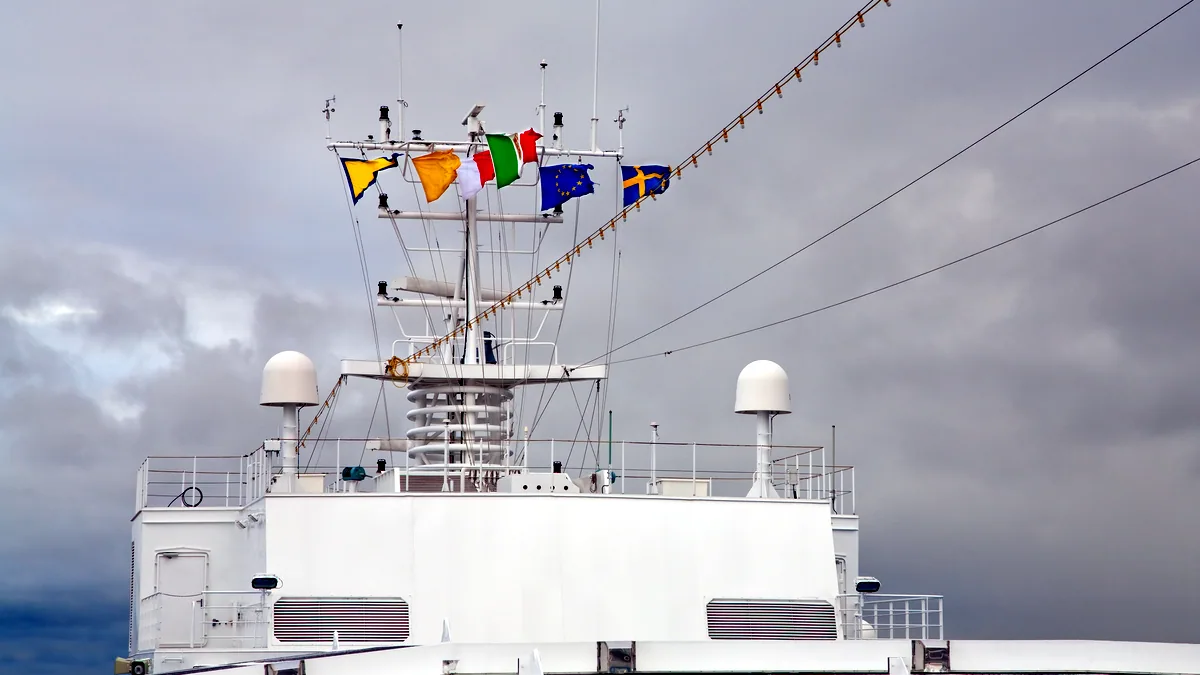
Every destroyer in the fleet, from the C-class ships of the 1910s to the Type 45 ships of today, flies this same kit, and the set is completed by the black flag of naval contracts, the signal of a ship under repair at a dockyard. The first step in reading any of these signals is to know exactly which cloth is which, and this page defines each group in turn, letter by letter where the alphabet is concerned, and it closes with the resynced terms of that black flag, so that a reader of Name memorabilia of Royal Navy destroyers has the full visual record alongside the name records.
Two rules decide which flag a ship flies and when. The naval jack flies from the jackstaff at the bows, and a warship hoists it on the first day of each month, so that the fleet presents its jack in public on 1 June and again on 1 January. The white, blue and red ensigns follow the second rule: the white ensign is the war flag and flies from the mast from sunset of one day to sunrise of the next, the blue ensign is reserved for the Royal Navy's commissioned vessels when in commission, and the red ensign, the "Red Duster", flies from merchant ships on the opposite half of the globe to the Union Jack. Royal Navy destroyer classes are the unit of design that carries all of this kit forward, and the class name, not the individual ship's name, is what the records attach each flag to.
The flag alphabet, A to Z
The flag alphabet is a set of 26 swallow-tailed cloth squares, one for each letter, and each letter is a single call of the fleet's code flag language. The shapes are fixed by tradition, and a reader who knows the 6 colours in play, red, white, blue, yellow, black and green, can work out most of the letters by elimination. The table below lists all 26 letters, their colour or pattern, and the first word each letter stood for in the classic British code flag lists.
| Letter | Design | First code word |
|---|---|---|
| A | White with a red disc, the "Able" | A |
| B | Yellow with a white disc, the "Bee" | B |
| C | Red with a white disc, the "See" | C |
| D | Blue with a white disc, the "Dee" | D |
| E | White with a red disc and a red diagonal stripe | E |
| F | Yellow with a white disc and a yellow diagonal stripe | F |
| G | Red with a white disc and a red diagonal stripe | G |
| H | Blue with a white disc and a blue diagonal stripe | H |
| I | White with a red diagonal band, the "Eee" | I |
| J | Yellow with a white diagonal band | J |
| K | Red with a white diagonal band | K |
| L | Blue with a white diagonal band | L |
| M | Yellow with a white triangle, the "Em" | M |
| N | Green with a yellow triangle, the "En" | N |
| O | Red with a blue triangle, the "Ow" | O |
| P | Blue with a red triangle, the "Pee" | P |
| Q | Green with a white triangle, the "Cue" | Q |
| R | White with a black triangle, the "Are" | R |
| S | Yellow with a black triangle, the "Ess" | S |
| T | Blue with a white triangle and a red stripe | T |
| U | Red with a yellow triangle, the "You" | U |
| V | Blue with a white triangle and a blue stripe | V |
| W | Yellow with a white triangle, the "Double-You" | W |
| X | White with a black triangle, the "Ex" | X |
| Y | Blue with a white triangle and a red stripe, the "Why" | Y |
| Z | Red with a white triangle, the "Zee" | Z |
Beyond the letters, the numeral flags 0 to 9 are small squares of black, yellow, red, white and blue, and the 4 special flags, the blue "Answer" flag, the red "Substitute" flag, the white "Repeater" flag and the black "Cancel" flag, close the working set at 40 pieces of cloth in total. A destroyer hoists these from the jackstaff, the masthead, the yard and the flagstaff in combination, and a trained signal officer reads a 3 flag group in under 5 seconds at sea.
The numbers and the specials
The numeral flags carry the second half of the alphabet's job, which is to send groups that mix letters and figures, such as a course given as "E 5 0" or a range given as "N 7 2". The special flags stand in for meaning: the Answer flag says "I understand you", the Substitute flag stands in for any letter the sending ship does not have, the Repeater flag says "repeat the last signal" and the Cancel flag strikes the whole group that follows it. A ship that flies the Cancel flag is telling the fleet that the next group supersedes the last one, and it is the only flag in the alphabet that erases.
The jack and the ensigns
The jack and the ensigns are the 3 national cloths that sit above the alphabet and give it its authority. The naval jack carries the Union Flag in the canton with a blue field behind it, and it flies only from the jackstaff, which means it appears at the bow and never at the mast. The 3 ensigns split by service: the white ensign for the Royal Navy in commission, the red ensign for the merchant marine and the blue ensign for the navy's other duties, and each one carries the Union Flag in the upper hoist, the square at the staff end. A destroyer on station flies the white ensign from the mast and the jack from the bow, and at sunset the jack is struck while the ensign is hauled up, a 2 flag change that the watch logs in the ship's log.
The black flag of naval contracts
The black flag of naval contracts is the small plain black cloth that a warship flies when it is in a dockyard for repair, and it is the only flag in the Royal Navy's kit that marks a ship as out of action rather than in it. The flag flies from the flagstaff at the main mast, not the jackstaff, and it tells the harbour master, the dockyard and any visiting vessel that the ship is on a contract, meaning a block of repair or refit work agreed between the navy and the yard. While the black flag flies, the ship's pennant is struck, and the crew reads the flag as a pause: the ship is still Royal Navy, but the pennant that named her is resting. The black flag of naval contracts, in its resynced form, was redrawn when the navy revised the contract system so that the flag's meaning now matches the yard's work orders line by line, and the resynced version is the one a modern ship flies at Rosyth, Devonport and Portsmouth.
How the resynced terms changed the flag
The resynced terms of the naval contracts black flag changed 3 things that the old flag had left ambiguous. First, the flag now flies for the full duration of a contract, not just for the first week of a refit, so a dockyard visitor can read the whole block of work from a single hoist. Second, the flag now pairs with the ship's pennant in a set, and the pennant is struck at the same instant the black flag is hoisted, so the pair reads as one statement about the ship's status. Third, the resynced terms fixed the flag's size at the standard 3 foot by 5 foot yard cloth, the same size as the numeral flags, which means a ship flying it in a foreign harbour presents a cloth that fits the rest of its kit rather than a larger yard flag. The resynced black flag is the last piece of the destroyer's flag record, and with the alphabet, the jack, the ensigns and the pennant it completes the 5 cloths that a Royal Navy destroyer flies at sea and in harbour.